9 February 2009

a reporter mice for calcium imaging [guest-post]

ResearchBlogging.orgCalcium imaging is a technique that is definitely coming to age, and fancier and fancier genetically encoded indicators are constantly being developed.

Different approaches have been taken for in-vivo imaging, some of which rely on the use of an optical fiber, or “fibroscope”, which is then attached to a (generally two photon-) microscope. This is clearly an invasive method and limits the observation to the limited zone of action of the fiber. Another less invasive approach is to use long working-distance objectives to image an exposed region of the body: this has been succesfully used, for instance, to look at dendritic spine plasticity in the neonatal brain over several days through a transparent window in the skull (Gray et al., PlOS Biology 2006). However, this also involves very delicate surgery and allows imaging over a limited area.

The approach recently described in PlOS One by Rogers and colleagues, instead, is completely non invasive. They generated a transgenic mouse line expressing the calcium sensitive protein GFP-aequorin in an inducible manner (through the use of a floxed-stop approach).
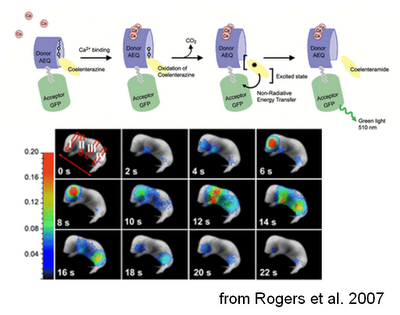
The reporter can therefore be targeted to the cell type of interest just by crossing this mouse with a line expressing Cre in that cell type. In the presence of Ca2+, the aequorin part of the probe can oxidize a substrate called coelenterazine, producing luminescence, that in turn excites the GFP, making it fluoresce. The idea is then to inject coelenterazine and look at the GFP-generated fluorescence. This method allows whole-animal imaging, although this obviously comes at the price of a lower spatio-temporal resolution (which is still pretty good in my opinion).

And indeed, it seems to work quite well! When GFP-aequorin was targeted to the mitochondria and expressed in muscles, it allowed imaging of mitochondrial calcium during muscular contraction. This was tested after an “artificial” contraction following tetanic stimulation, in physiological conditions, such as the spontaneous muscular activity in newborn mice, and during an induced “pathological” condition, kainate-derived seizures. To see the system in action I strongly advice to have a look at the cool videos attached to this open-source paper.

In summary, this approach allows a non-invasive and quantifiable whole animal imaging of physiological and pathological states. It may also be a very interesting indicator for measurement of the metabolic state of a certain tissue, apoptosis and many other processes that depend on calcium. Of course the next step to this would be to have such a system working in freely-moving animals. Are we really so far away from this? I don't think so, expecially as the same group already published an article about it (Roncali et al., J. Biomed. Opt. 2008)!

Kelly L. Rogers, Sandrine Picaud, Emilie Roncali, Raphaël Boisgard, Cesare Colasante, Jacques Stinnakre, Bertrand Tavitian, Philippe Brûlet (2007). Non-Invasive In Vivo Imaging of Calcium Signaling in Mice PLoS ONE, 2 (10) DOI: 10.1371/journal.pone.0000974

Nicola Romanò is a neuroendocrinologist, interested in the analysis of the electrical/calcium activity of hypothalamic neurons governing pituitary hormonal secretion. He presently studies the neuroendocrine control of the prolactin axis. He also writes on the Inside Neuroscience blog (in Italian) on MolecularLab.it. As an "imaging person" he loves photography. His photo portfolio (not science-related) can be found at www.nicolaromano.net

26 comments:

nico said...

Just for the sake of completeness: the first (to my knowledge) attempt of invasive in-vivo imaging in freely moving animals dates back to 2001 (!!) (Helmchen et al., Neuron 2001)

Gianpaolo Rando said...

Thanks for the great post nico, and for your comprehensive view. Concerning your comment, you are right: even if we stand on the shoulder of giants, sometimes we consider very brand new something quite dated. Actually, I had some very hot data for which I was very excited (I cannot disclose more: the paper is still under revision). However, reading some old literature I found reminescences on that discovery dated 1931!

Bugpowder said...
This comment has been removed by the author.
Bugpowder said...
This comment has been removed by the author.
nico said...

First of all I wouldn't judge a paper by the journal it is published in. There's lot of horrible paper published in Nature, if you know what I mean.

I understand your points, but if when they started doing heart transplants they stopped because of the high failing rate where would we be now?

Spatial resolution and temporal resolution are things that can be improved, and I'm sure they will. And if you're looking at the whole body... maybe you don't need cell resolution. Even if you had it you'll be computationally limited for the analysis of the results.

Sure, two photon microscopy is cool (WHEN it works), but can anyone do whole-body two photon imaging in a freely-moving animal?

I think that, with proper 3D reconstruction of the signals, this technique could have very interesting applications in the neuroscience field for neuronal population imaging.

Bugpowder said...

Edited for excessive beer consumption :-P

The technique is interesting. I'm really impressed with the amount of signal increase you get with GFP-Aequorin fusion proteins over Aequorin alone due to the enhanced proteins stability. That is cool. The SNR is pretty amazing, I would think background Ca levels were sufficient to have more calcium activation, but I guess the affinity of the construct is in the sweet spot. Also cool is that it works in vivo. Isn't there genetically encoded coelenterazine now? Can this be expressed at a high enough level in these tissue without messing up the animal.

The main problems are

1) spatial resolution being 3 orders of magnitude worse that 2-p microscopy.

2) The wavelength of light is not well suited for in vivo imaging. Light travels diffusionally through highly scattering tissue (like our bodies). Since blood is so absorbent below 600nm, very little light can get out. Moreover, I think slight variations in tissue thickness during movement are going to cause big motion artifacts as the path length through the tissue changes. It's not as much of a problem with luminescence as with fluorescence (don't need to get the light in), but still a big issue.

It looks promising, but right now I'm not sure what you can learn with it that we don't already know. IF they could couple it to a longer wavelength emitter, something around 650nm +, then this technique would start being really useful. mKate2 would be good, or some new infrared fluorescent proteins that will be out soon. Getting the energy transfer out to that long a wavelength is going to be tough. I'mnot aware of anything with a large enough Sto kes shift. Maybe a hetero-FP dimer.

Yes and PLOS one is cool.

Gianpaolo Rando said...

Recently, more than one opportune approach with fluorescent proteins led to break the Abbé limit and get optical resolution at nanometer scale. I would not be surprised if someone, elaborating on that concept, will gain a better resolution of fluorescent mice.

Bugpowder said...

The resolution limit is going to be governed by light scattering in tissue and the shot noise of the source. The super-resolution techniques are not applicable in these circumstances. Luminescent emission is non directional and the source is distributed. It will be hard to get beyond current resolution in a moving sample. You can do some 3D tomography on it, but still this technique is going to be good for looking at large changes in a chunk of tissue. If you were just looking at a single point source, you could get better resolution, but the photon output is going to be pretty low.

Dissertation Sample said...

good post and nice blog, I really like this type of interesting articles keep it up.

Dissertation Help said...

This blog is very nice and informative. it is pretty hard task but your post and experience serve and teach me how to handle and make it more simple and manageable. Dissertation Help | Custom Dissertation

Dissertation Writing Service said...

This is a very nice blog,I have seen this variety of post after a elongated moment. I value your endeavor for compiling such post.

Dissertation Writing Service

Dissertation Writing Help said...

hmm...your post is good. i really like it. . .nice job keep sharing ;)
UK Dissertation Help

KATIE DOYLE said...

I am surfing via google and i found your blog full of interesting material really enjoyed here and i am wondering that you will keep updated on every post.

Narrative essay format
Personal narrative essay format
Academic Writing

reseller web hosting said...

Love the attitude, not much to say, which is really rare for me, but I am trying to behave, which is really rare too. Great post I loved it.


reseller hosting |
cpanel reseller

Expert said...

Thanks a lot for your overwhelming participation and appreciation of the different activities The post is pretty good. I really never thought I could have a good read by this time until I found out this forum. I am grateful for the information given.
dissertation writing | dissertations | dissertation help | write dissertation | dissertation examples | buy dissertation | dissertation proposal

Junaid Ahmed said...

This is a very nice blog, like this type of interesting articles

Nokia Applications | Nokia Games | Nokia Themes | Nokia Prices | Nokia Reviews

UK Dissertation Writers said...

a reporter mice for calcium imaging [guest-post] <-- that's what i was looking for
Masters Dissertation Writer

THESIS PAPERS HELP said...

Nice Buddy
Thesis Paper Writing

dissertation help online said...

really loved reading your thoughts, obviously you know what are you talking about! Your site is so easy to use too, I’ve bookmark it in my folder
master dissertation help | dissertation topics | uk dissertation | Dissertation Writing Services

UK Dissertation said...

i really like your post .. i will like to bookmark your site for my future needs :)
dissertation writing services

dominos coupons said...

reportergene.com is one of the best websites that i have ever found.. lots of useful information here. Thanks and cheers mate.

dominos coupons

Make iPhone Apps said...

This is nice-looking very interesting. I actually never thought I could have a good read by this time until I set up out this forum. I am thankful for the given particular information.

Dissertation Writing Help said...

This is amazing awesome to read. I am going to bookmarked it for a research.

Design a Logo said...

It is my second visit to your blog. We are starting a product new proposal in the same niche as this blog. Your blog provide us with important information to work with. You have done a wonderful job.

seo forums said...

Thanks for sharing this post, which is really helpful to me. Keep updating more.

5 Star Cincinnati Hotels said...

nice blog keep sharing;). I hope you have more information about this post. Thanks for sharing the great websites.

Post a Comment

Most viewed posts